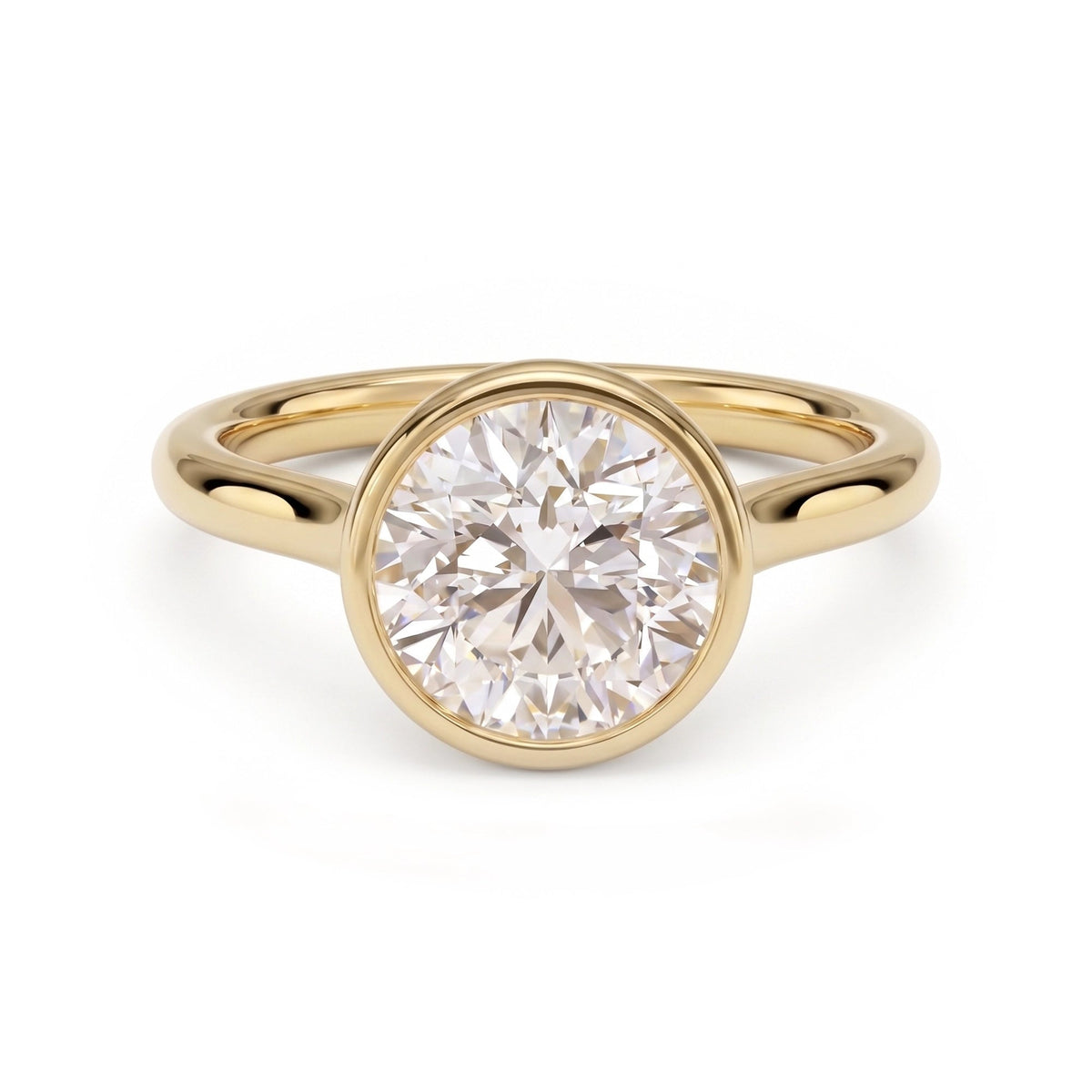
A full bezel gives a diamond a continuous metal frame. Prongs leave more of its outline exposed. Both can make a beautiful engagement ring; the useful choice is the one that fits your taste, daily routine and willingness to care for the finished piece.
Start with the view you prefer, then compare the ring from the side and ask how it should be maintained. A setting name alone cannot tell you how a particular ring will feel, wear or sparkle.
Bezel and prong settings at a glance
| What to compare | Bezel | Prong |
|---|---|---|
| Metal around the center | A rim follows the diamond's edge; a full bezel surrounds it | Separate metal tips hold the diamond at selected points |
| Visual starting point | A defined frame around the stone | A more exposed outline with visible prong details |
| Daily wear questions | How high is the setting, and how smooth is its rim? | How high is the setting, and are the tips smooth and properly fitted? |
| Cleaning questions | Can you reach the underside of the stone? | Can you clean around the tips and beneath the stone gently? |
| AIOVO design to explore | Luna Round Solitaire Ring | Classic Four-Prong Solitaire Ring |
GIA describes these setting structures in its guide to solitaire settings. A solitaire describes a ring centered on one stone; that stone can be held by a bezel or by prongs.
Compare the frame around the diamond
A full bezel traces the stone's perimeter in metal. Prongs create individual contact points, leaving spaces between them. Those details give you two different ways to see the relationship between the diamond and its setting.
Use Luna Round Solitaire Ring as a starting point for the bezel look. Its current product page identifies a bezel that encircles the round center stone. If a clear metal outline is the detail you keep returning to, put Luna on your shortlist.

For the prong look, explore Classic Four-Prong Solitaire Ring. Its four-prong design offers a different visual reference. Look closely at the tips, the gaps between them and the side profile rather than comparing only the center stone in a cropped photograph.

These are two complete designs, not a controlled test of settings. Their bands differ: the current pages list Luna at 2.0 mm and Classic at 1.4 mm. Compare the whole composition before deciding which detail is responsible for your preference. Ask to see the metal and center-stone option you are considering; a photograph of a sample does not establish the dimensions of every available option.
Match the setting to your daily routine
GIA notes that a bezel provides coverage around the diamond's sides and can suit people concerned about catching a ring on clothing or gloves. Prong settings expose more of the stone. This is a useful design consideration, not a guarantee that every bezel is snag-free or that every prong ring will catch. See GIA's engagement ring buying questions.
Think about the situations in which you plan to wear the ring. Do you regularly handle knitted fabrics, wear gloves or work with your hands? Tell your jeweler which situations matter and ask about the specific design. Follow workplace rules where jewelry must be removed.
Ask for a side view with a clear scale reference. Compare the height above the finger, the underside of the setting and the transition into the band. If you intend to wear a wedding band alongside it, request a view of the proposed pairing. Do not assume that a bezel sits low or that a prong setting leaves room for every band.
Understand protection and maintenance
A diamond's resistance to scratching is different from its resistance to breaking. GIA explains that diamonds can chip or fracture after a sufficiently hard impact. It also notes that a loose diamond can wear against the metal holding it. Both settings deserve attention to the condition of the finished ring. GIA Diamond Care and Cleaning Guide.
Ask your jeweler what an inspection should cover and how often your particular ring should be checked. Bring a change to their attention: a tip that begins catching, a visibly bent section of metal, or a stone that seems to move. Have the ring assessed before continuing to wear it; do not try to tighten the setting yourself.
For a bezel, ask how the rim and stone fit will be inspected. For a prong ring, ask how the tips and their contact with the diamond will be checked. Choose the design whose care requirements you understand and are comfortable following. Neither choice removes the need for maintenance.
Keep the diamond clean
For diamond jewelry in sound condition, GIA recommends gentle cleaning with water and a little mild dish soap, followed by careful use of a soft, clean toothbrush and drying with a lint-free cloth. Clean gently around the setting and, where accessible, behind the diamond. Avoid chlorine bleach and abrasive cleaners, including toothpaste. Consult a jeweler before ultrasonic cleaning, which can loosen stones or cause damage in some circumstances. GIA's diamond cleaning advice.
Ask for cleaning instructions for the exact ring, including its metal, finish and any additional stones. Examine the underside before choosing: can you reach it with the recommended brush, or will you need help with cleaning? That practical question is more useful than assuming one setting is always easier to clean. If the ring needs repair, have that addressed before cleaning it at home.
Compare sparkle in the actual ring
More exposed diamond does not establish a measured sparkle advantage. GIA explains a diamond's light appearance through brightness, fire and scintillation, with cut proportions and craftsmanship affecting the result. GIA's introduction to diamond cut.
When comparing Luna and Classic, request views under similar lighting and at similar camera distances. Include a slow tilt and ordinary diffused light as well as any brighter display lighting. Compare what you enjoy seeing rather than treating the setting name as a brightness score.
Keep the diamond's shape, dimensions and report details in the comparison. If you are also choosing between oval and round, read Oval vs. Round Diamonds first, then return to the setting decision. For grading basics, use AIOVO's 4Cs guide.
Build a shortlist you can explain
Choose a bezel starting point if you prefer a continuous frame and want to discuss a smooth perimeter with your jeweler. Choose a prong starting point if you prefer the exposed outline and individual metal tips. Then test that preference against the side profile and the care questions that matter to you.
Save Luna and Classic and write down what attracts you to each. Before deciding, confirm the selected metal, center-stone specifications and ring size; request the views you need; and clarify cleaning and inspection requirements. If you want a different combination of details, bring your shortlist to AIOVO Custom Design. The aim is a ring whose appearance and care fit the way you plan to wear it.


