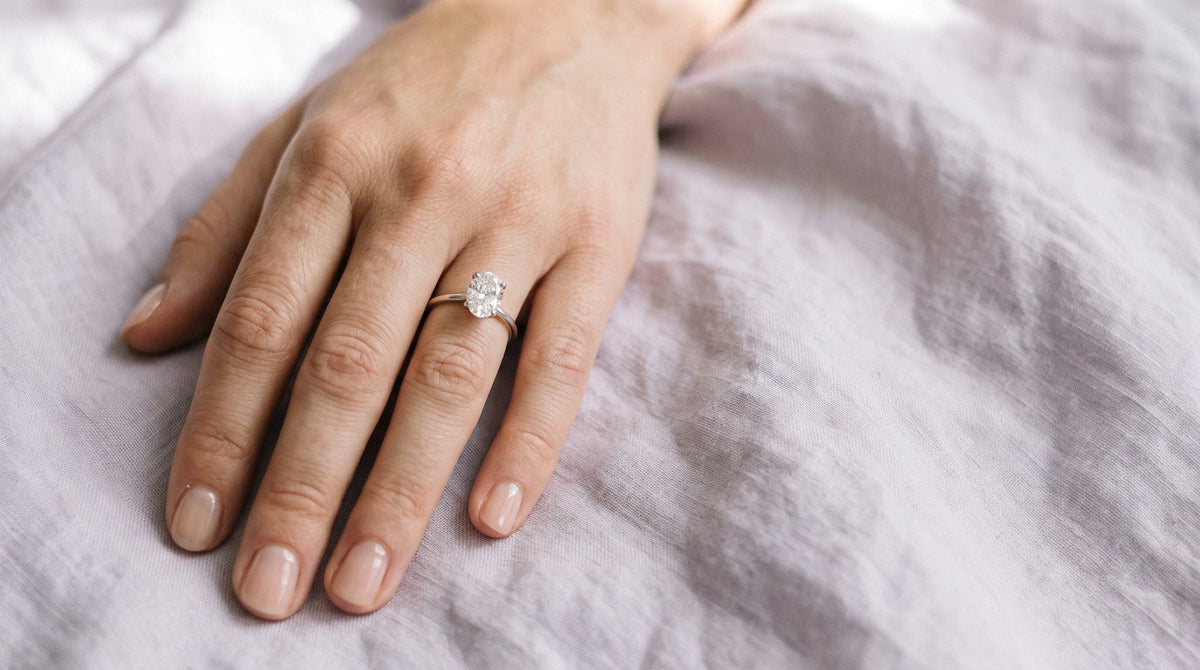
Ask anyone why an engagement ring goes on the fourth finger of the left hand, and you'll probably hear the same romantic answer: because there's a vein in that finger that runs straight to your heart.
It's a lovely story. It's also not true.
The real history of the ring finger is stranger, and honestly more fun. It involves a tale about ancient Egyptian anatomists, a Roman book of trivia, an English church lawyer's marriage treatise, a prayer book that moved England's wedding rings to the left hand, and a surprising number of people today who wear their rings on the right hand. Here's how one small finger ended up carrying such a big promise.
The legend: a "nerve" from the finger to the heart
One of the earliest surviving versions of the story comes from the Roman writer Aulus Gellius, who collected curiosities in a book called Attic Nights in the 2nd century AD.

Gellius notes that the ancient Greeks, and most Roman men, wore their rings on the finger of the left hand next to the little finger. He then passes along an explanation from Apion, an Egyptian-born scholar. According to Apion, when Egyptian anatomists opened up human bodies, they found a very fine nerve running from that one finger all the way to the heart. Since the finger seemed joined to the body's most important organ, it made sense to honor it with a ring.
Notice two things. First, the ancient version talks about a nerve, not a vein. Second, these rings weren't necessarily engagement rings at all; it was simply where people liked to wear a ring.
A few centuries later, the writer Macrobius repeated the idea in his Saturnalia, again calling it a nerve and again pointing to Egypt. In the 7th century, Isidore of Seville told a similar story about rings on the fourth finger, this time describing a vein that reached the heart.
Where "vena amoris" actually comes from
The famous Latin name, vena amoris ("the vein of love"), arrived much later than most people think. Its best-known early use is by Henry Swinburne, an English church lawyer, in a treatise on marriage contracts published in 1686, after his death.
Swinburne wrote that the wedding ring belongs on the fourth finger of the left hand because a vein of blood, the vena amoris, runs from it to the heart. By then the ancient "nerve" had become a vein, and the vein had become a symbol of love. The legend had found its final, romantic form.
So, is there really a vein of love?
Sorry, romantics: no.
In the 17th century, the English physician William Harvey showed how blood actually circulates: veins from every part of the body carry blood back toward the heart. Your ring finger has no special express line. Anatomically, it is connected to your heart exactly as much as your pinky, your thumb, or your big toe.
The ancients weren't foolish, though. Before anyone understood circulation, the fourth finger was surrounded by a whole set of beliefs:
- In Latin it was called digitus medicinalis, the "medical finger," a name borrowed from Greek. Old English had its own version, the leech finger, because "leech" was an old word for a doctor.
- Some people believed that wearing a ring on it, or pinching it, could help with heart trouble.
The finger was special long before it was romantic. The "vein of love" just gave that old feeling a beautiful name, and beautiful names tend to stick.
England's turning point: a prayer book in 1549
If the vein didn't put the ring on the left hand, what made it the standard in England and the English-speaking world? Mostly, the church.
In medieval Christian weddings, the ring was sometimes placed on the bride's left hand one finger at a time: thumb, index, middle, and finally the fourth finger, where it stayed. It was a small piece of ceremony, and the fourth finger was where the journey ended.
But "left hand" was far from a universal rule. In early 16th-century England, the usual practice was actually to put the ring on the bride's right hand.
Then came 1549. Under the young King Edward VI, England's first Book of Common Prayer set out the wedding service in detail and specified the fourth finger of the bride's left hand. In 1614, the Catholic Church's official service book, the Rituale Romanum, also followed the left-hand placement.
Even then, habits changed slowly. Many English Catholics kept the right-hand custom until around the mid-1700s. And in the 17th and 18th centuries, a ring could end up on almost any finger after the ceremony. Some people wore their wedding ring on the thumb.
So the modern "rule" is less an ancient law of love and more a few hundred years of church ritual, slowly becoming habit.

Left or right? It depends where you're standing
If you grew up in the US, the UK, Canada or Australia, the left ring finger probably feels like the only option. Travel a little and you'll find plenty of happily married people wearing their rings on the right.

| Where | Engagement ring | Wedding ring |
|---|---|---|
| US, UK, Canada, Australia, France, Italy, Japan | Left | Left |
| Germany, Austria, Denmark | Usually left | Traditionally right |
| Norway | Varies (traditions differ) | Traditionally right |
| Russia, Ukraine, Greece, Serbia | Varies; in the Orthodox betrothal rite, rings go on the right | Traditionally right (Orthodox rite) |
| Brazil | Engagement bands often on the right | Traditionally moved to the left at the wedding |
| Argentina | Engagement bands often on the right | Wedding ring on the left |
| Spain | Varies by region | Right in many regions, left in places like Catalonia and Valencia |
| India, the Netherlands | Either hand | Either hand, by family and tradition |
Customs vary by family, faith and region, so think of this as a general guide rather than a rulebook.
A few traditions worth knowing:
- Germany and Austria: the "switch." Before the wedding, the engagement ring usually sits on the left hand. Afterwards, some brides move it to the right to sit with the wedding band, while others keep it on the left. Traditionally, left is the promise and right is the marriage, but both ways are common today.
- Brazil and Argentina: engagement bands for both. Couples often exchange simple matching bands when they get engaged and wear them on the right hand. In Brazil, those bands traditionally move to the left hand on the wedding day; in Argentina, the wedding rings are worn on the left.
- Orthodox weddings: the right hand. In Russian, Ukrainian, Greek and Serbian Orthodox ceremonies, the ring traditionally goes on the right hand, which has long symbolized strength and blessing.
- Ireland: the Claddagh code. With a Claddagh ring (two hands holding a crowned heart), how you turn the heart tells a story. Worn on the left hand, a heart pointing outward traditionally means engaged, and pointing inward means married. (On the right hand, outward means single.)
So which hand should your ring go on?

Honestly? Whichever one feels right to you. No vein, law or prayer book is checking. Still, a few practical points help:
- Follow your family's tradition if it matters to you. If your parents or grandparents wore their rings on the right, carrying that on is a lovely way to honor them.
- Think about your dominant hand. Many people choose their non-dominant hand simply because the ring takes fewer knocks there, which helps if you work with your hands.
- Size the finger you'll actually wear it on. Fingers on your dominant hand are often a touch larger, so if you're right-handed, a ring sized for your left hand may feel snug on your right. Our Find Your Fit guide shows how to measure at home, or skip the guesswork: order our free ring sizer and we'll mail it to you.
- Planning to stack? A common Western custom is to put the wedding band on first, closest to your heart, with the engagement ring on top. Some couples flip it, and some wear one ring on each hand.
The tradition is a story, not a requirement. What matters is the person who put the ring there.
A small finger, a very old promise
The vein of love may be a myth, but the feeling behind it isn't. For nearly two thousand years, people have looked at that quiet fourth finger and decided it was the right place to keep something that matters. That part of the story is completely true.
If you're getting ready to write your own chapter, here are two easy places to start:
- Get the size right, secretly or not. Our free ring sizer ships straight to your door, so you can measure the exact finger (and hand) the ring will live on.
- Make it personal. Every AIOVO lab-grown diamond engagement ring includes free engraving inside the band. A date, initials, or a word only the two of you understand: a little vena amoris of your own.
Browse lab-grown diamond engagement rings
Quick answers
Which finger does an engagement ring go on?
In the US, UK and most English-speaking countries, the fourth finger of the left hand. Elsewhere it varies. In Germany and Austria, for example, the engagement ring usually starts on the left while the wedding ring goes on the right, and in Russia, Greece and parts of Spain the wedding ring is traditionally worn on the right.
Is the vena amoris real?
No. It's a legend. Ancient writers described a nerve linking the fourth finger to the heart, and later writers turned it into a "vein of love." In reality, veins from every finger lead back to the heart.
Why is it called the ring finger?
Because it's the finger traditionally chosen for rings. One of its Latin names, digitus anularis, literally means "ring finger."
Can I wear my engagement ring on my right hand?
Absolutely. Plenty of people do, by tradition or by choice. Just make sure the ring is sized for the hand you'll wear it on. Our free ring sizer, mailed to your door, makes that easy.
Do I wear the engagement ring or the wedding band first?
A common Western custom is the wedding band first (closest to your heart) and the engagement ring on top, but there's no wrong order.


