Oval and round diamonds can both make a beautiful engagement ring. The useful question is which outline, light pattern and setting you want to see every day. Choose oval if you are drawn to an elongated silhouette and are willing to compare individual stones closely. Choose round if you prefer a circular outline and a balanced, symmetrical look.
This guide compares the two shapes and gives you a practical way to build a shortlist.
Oval vs. Round: A Quick Comparison
| What matters to you | Oval | Round |
|---|---|---|
| Outline | Elongated, with proportions that vary from stone to stone. | Circular, with an evenly balanced outline. |
| Visual presence | May look larger face-up at the same carat weight; check actual measurements. | Compare diameter and the complete setting rather than carat alone. |
| Light pattern | Assess brightness and central contrast in the individual stone. | Assess the individual stone's cut and appearance in motion. |
| A key inspection point | Outline, length-to-width ratio and bow-tie visibility. | Report details and the balance of bright and dark areas. |
| A good starting point | You prefer a longer outline and want to compare different oval proportions. | You prefer a circular outline and a symmetrical composition. |
Start With the Silhouette
Round gives a centered focal point; oval extends that outline along the finger in a north–south setting. These are design choices rather than rules about who can wear each shape. Try comparing the complete rings: band width, side stones and the setting's orientation all change the composition.
Browse Oval Engagement Rings and Round Engagement Rings. Save one design from each collection before comparing specifications. This helps separate your preference for the diamond's outline from your preference for a particular band or setting.
Which Diamond Looks Larger?
Carat measures weight, not visible size. Compare the actual millimeter measurements on the report and, where available, views of the actual stone or finished ring. Equal carat weight does not guarantee equal face-up dimensions.
An oval may have a larger-looking face-up presence than a round at the same weight, as described in GIA's oval buying guide. That is a tendency, not a fixed percentage or a promise for every pair. Proportions and setting affect what you see.
Product photographs help you judge a design, but photographs taken at different scales cannot establish a size advantage. A styled image also does not prove which carat option is selected on the product page. For a meaningful on-hand comparison, ask for the stone measurements and the photographed ring specifications. This article does not present a measured on-hand comparison.
Compare Sparkle in the Actual Stone
Both shapes are commonly cut with brilliant-style faceting. Outline alone does not determine which individual diamond will look brighter. GIA explains cut in terms of brightness, fire and scintillation: white-light return, colored flashes, and the changing pattern of light and dark as a stone moves.
Compare stones under similar lighting and camera conditions. Ask for a face-up view and a slow tilt, including ordinary diffused light rather than only spot lighting. A single still image cannot show how a diamond changes in motion. Use the report alongside the visual evidence instead of treating a shape name or a grade as a guarantee that one stone will outshine another.
For Oval Diamonds, Check Proportion and Bow-Tie Visibility
Length divided by width gives an oval's length-to-width ratio. It helps describe how long or broad the outline is; it does not independently establish cut quality. Choose the outline you prefer, then assess the individual stone.
A bow tie is a darker, bow-shaped area across the center of an oval. GIA explains that viewing conditions and the observer's obstruction of light affect its visibility. Some contrast can be subtle; a persistent dark area may be distracting to you.
Ask to see how the center changes when the stone tilts and when the viewing distance changes. A “bow-tie-free” label or a single favorable angle should not replace that assessment. Decide whether the contrast is acceptable to you in the actual stone, rather than rejecting every oval or assuming a particular ratio removes the effect.
Read GIA and IGI Reports in Their Own Context
Check the laboratory, report type and issue date for the actual stone. GIA's familiar overall cut scale applies to standard round brilliant diamonds in the D-to-Z color range, not automatically to ovals. For D-to-Z laboratory-grown diamonds, GIA introduced a separate Premium or Standard assessment from October 1, 2025; these terms are not a direct conversion for IGI grades.
IGI's methodology includes overall cut grading for fancy shapes. Distinguish that assessment from polish and symmetry, and check which fields appear on the specific report. Use IGI's report guide to locate measurements and grading information. If a listing uses shorthand, ask which laboratory and report field it refers to. For the basics, see AIOVO's 4Cs guide.
Choose the Setting Alongside the Shape
The existing oval designs offer three useful starting points. Compare their complete compositions to find the details you prefer.
Oval Solitaire
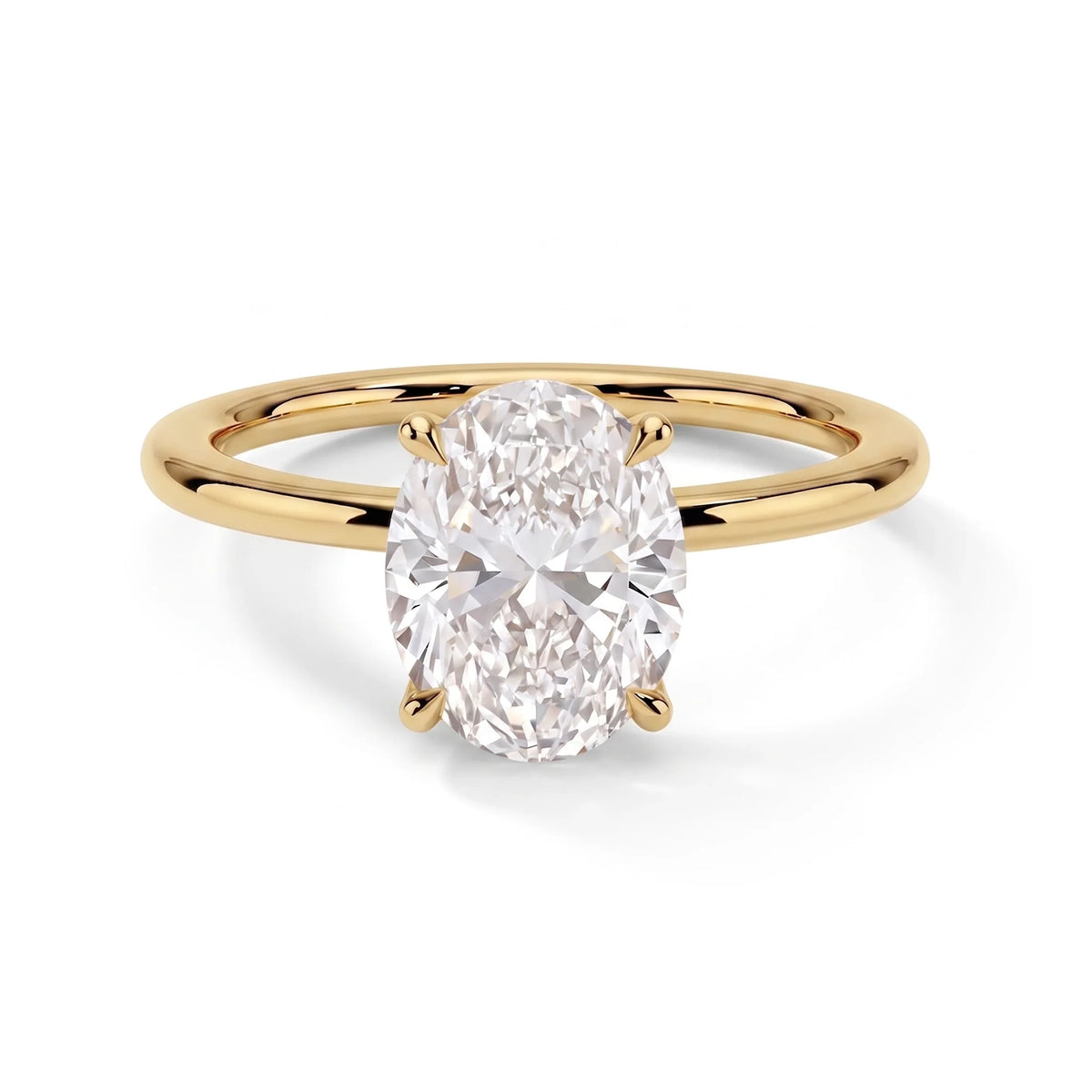
A solitaire keeps attention on one center stone. Start with the Flora Oval Solitaire Ring if you prefer a restrained composition.
Oval Hidden Halo
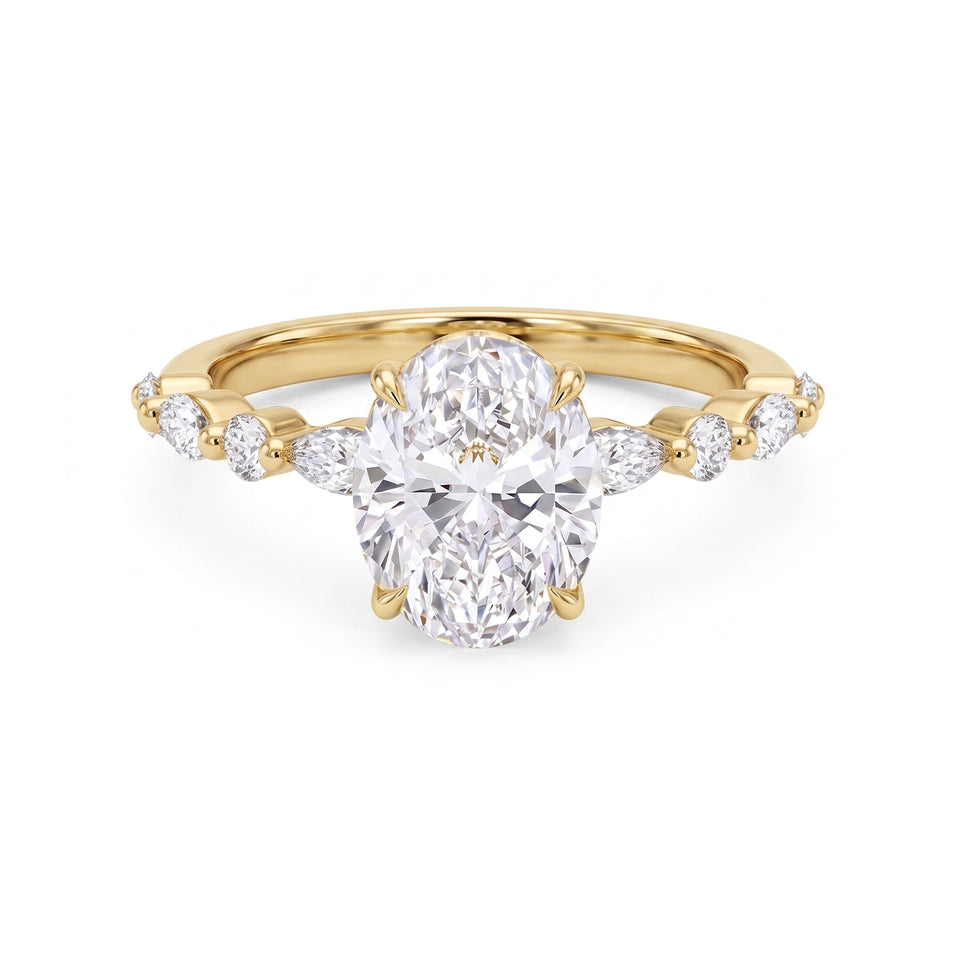
The Ivy Hidden Halo Oval Ring combines an oval center with a hidden halo beneath it and alternating marquise and round side stones along the band. Compare the side profile as well as the face-up view to decide whether you want that added detail.
Oval Three-Stone
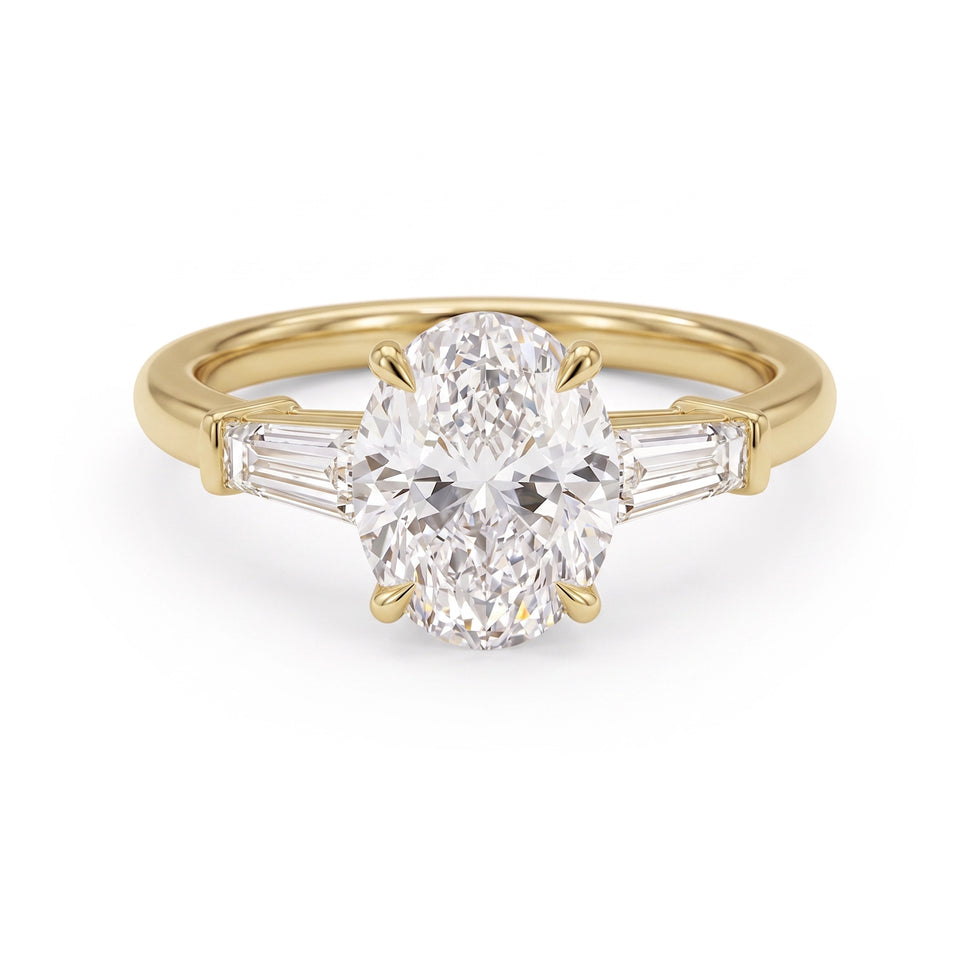
The Legacy Oval Three-Stone Ring offers a broader composition around an oval center. Review the whole setting if side-stone balance is part of your preference.
Round Solitaire and Bezel
For a round-centered comparison, look at the Luna Round Solitaire Ring, whose bezel encircles the center stone. For a four-prong setting reference, see the Classic Four-Prong Solitaire Ring.
Make Your Shortlist
Choose oval when the elongated outline is what you keep returning to, and compare individual stones for proportions and central contrast. Choose round when the circular outline and symmetrical composition feel right to you, and use the relevant report and visual evidence to assess the stone.
Before deciding, confirm the actual stone measurements, laboratory and report details; review the setting from above and from the side; and check the selected metal, center-stone weight and ring size.
Explore oval or round engagement rings to build your shortlist. If you want to discuss a different combination, start a custom design conversation. Bring the design references and questions you want answered; you do not need to settle the shape from a comparison chart alone.