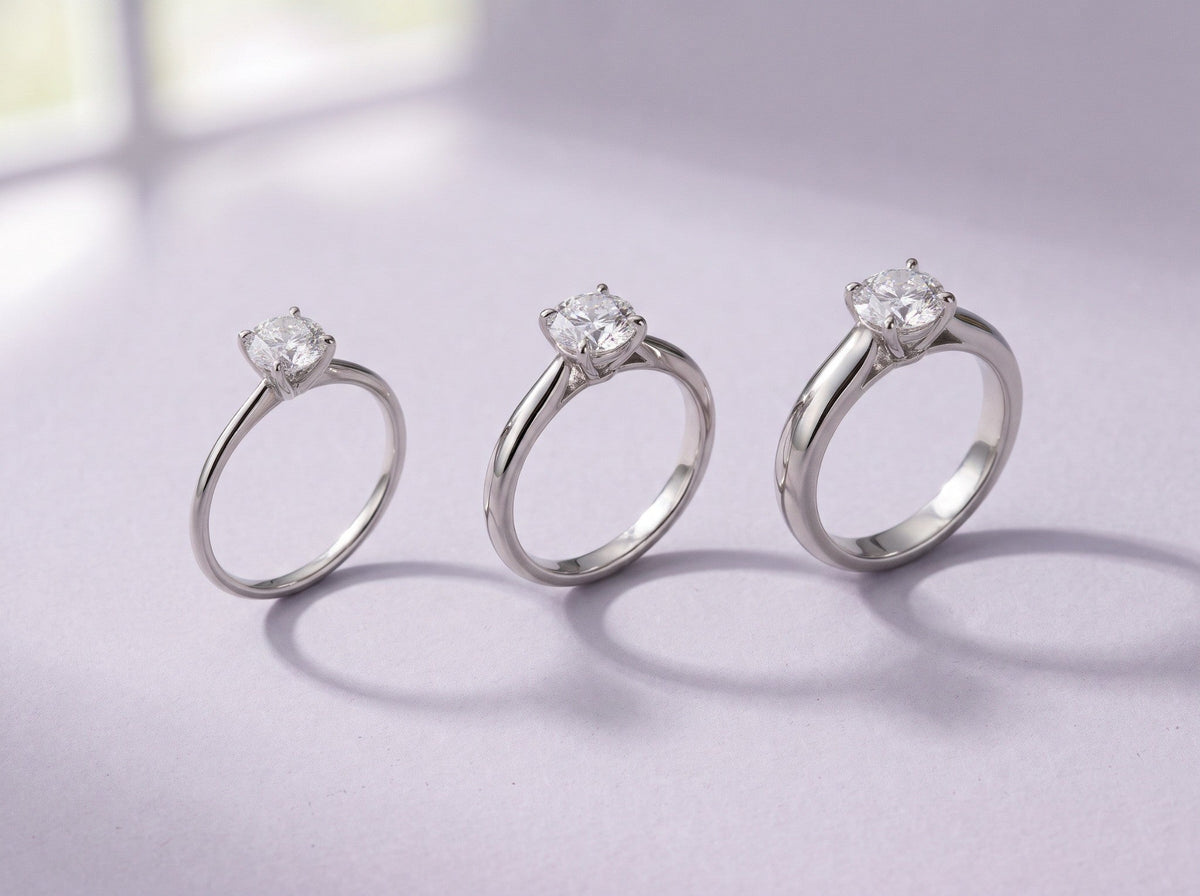
You may know which diamond shape you want and still hesitate between two rings. Look at the band next. How much of it do you want to see beside the center stone? Do you prefer a quiet line of metal, or a band whose details are part of the design?
Start with the listed width, then compare the whole ring and confirm the fit. A millimeter measurement helps you ask better questions; it cannot choose the ring for you.
Separate band width, thickness and ring size
The band is also called the shank. GIA distinguishes it from the head that holds the gemstone and the shoulders that connect the two in its guide to engagement ring settings.
Band width describes the distance across the band. Thickness describes the metal from its inner surface to its outer surface. Ring size describes the fit around your finger. These are different measurements: a 2 mm band is not a size 2 ring, and a listed 2 mm width does not tell you the band's thickness.
Ask where the width was measured, especially if the band narrows or widens as it approaches the center stone. If you are discussing a custom version, ask for the proposed finished width and thickness at the relevant points.
Use real rings as reference points
These AIOVO product pages offer four starting points. Each combines a listed band width with a different design, so compare the band and setting together.
| Ring | Listed band width | Detail to compare |
|---|---|---|
| Classic Four-Prong Solitaire Ring | 1.4 mm | The band alongside a four-prong center setting. |
| Flora Oval Solitaire Ring | 1.5 mm | The band beside an oval center with petal-like prongs. |
| Luna Round Solitaire Ring | 2.0 mm | The band in relation to the round center's continuous bezel. |
| Ivy Hidden Halo Oval Ring | 2.3 mm | Alternating marquise and round side stones, plus a hidden halo beneath the center. |
These figures describe the current listings. They are not strength ratings or a controlled comparison in which only width changes. Confirm the specifications of the metal, center stone and any custom details you intend to order.
Compare the balance around the center stone
Begin with a top view of the complete ring. Look at the band on both sides of the center, then at the transition into the setting. Decide whether you want the band to stay visually quiet or to contribute a pattern of its own.
For example, compare Flora and Ivy if you like an oval center. Flora offers petal-like prongs; Ivy adds side stones and a hidden halo. Their different widths are only part of what you are comparing. Write down whether your preference comes from the band, the decorative details or the entire composition.
Ask for comparable views with the photographed ring size and center-stone specifications identified. Different image crops and camera distances make side-by-side photographs unreliable as rulers. For the diamond outline itself, return to Oval vs. Round Diamonds; for how the center is held, use Bezel vs. Prong Settings.
Check comfort with the design you intend to wear
After narrowing your shortlist, confirm your size on the intended finger and hand. Our Find Your Fit guide covers measurement methods and explains why a similar-width sizer is useful. Wider bands can feel tighter, so do not automatically add half a size based on a width label.
During a fitting, notice how the ring passes the knuckle, sits at the base of the finger and feels when you bend your hand. Tell the jeweler if you are comparing it with a ring that has a different band width or inside profile. The useful result is a comfortable fit in the intended design.
If you plan to wear a wedding band alongside it, ask to assess the proposed pair together. Request a side view to check how the bands meet and whether the setting leaves the space you want. A band-width figure alone does not establish that two rings will sit flush.
Ask what the width figure leaves out
A product listing may give the width without specifying the band's thickness or the setting's height. Ask for those details if they matter to your decision. Do not treat the widest ring in the table as automatically the strongest, or assume the narrowest one is unsuitable for you.
Describe your routine and ask how the complete design suits it. If you want a wider or narrower version, ask AIOVO to review the proposed dimensions with the selected center stone, metal and side-stone arrangement. Confirm the design and price before deciding; changing the width is a design request, not a promise that every measurement can be substituted unchanged.
Build a shortlist with three clear answers
For each ring you save, answer three questions: What do I like about the band's appearance? Which dimensions still need confirmation? How will I check the fit, including any ring I plan to wear beside it?
Use the linked product pages to compare the listed designs. If your preferred combination is different, bring those answers to AIOVO Custom Design. A useful brief can be as simple as: “I like this center setting, prefer this band's visual weight, and would like to discuss the finished dimensions.”


